

Port Galveston Cruise Terminal 10
Galveston Wharves Cruise Terminal is a two story, 160,000 square-foot terminal building designed to maximize cruise terminal operations while creating a welcoming environment for passengers and crew...


Gain deeper insights into the maritime industry with detailed updates on key developments and trends, meticulously curated by our team of specialists.
Learn about what's fueling the region's growth and its future opportunities.
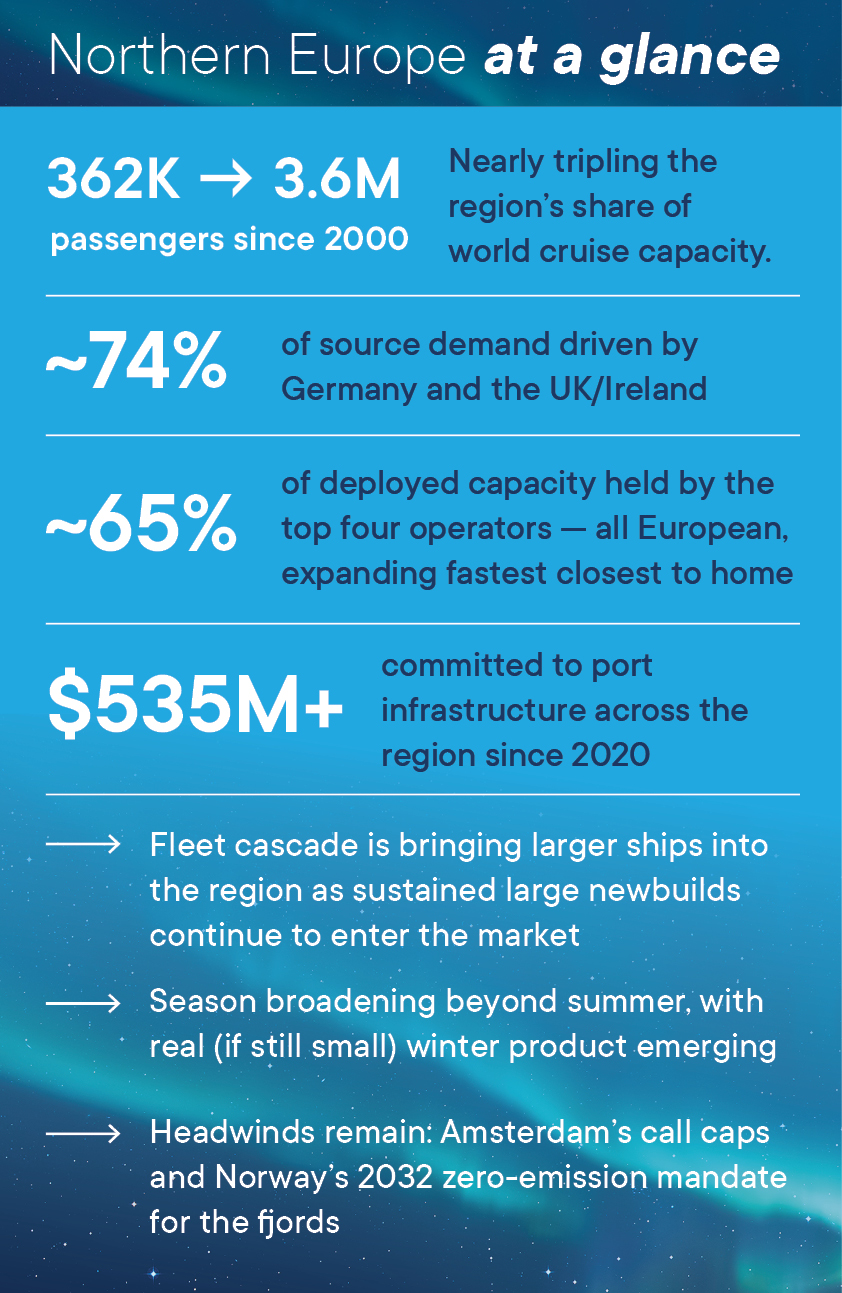
Northern Europe is the world's fourth-largest cruise region in 2026, representing roughly 9% of global capacity, behind the Caribbean, Mediterranean, and Asia/Pacific. But that ranking is a moving target: Northern Europe and Asia/Pacific have traded third and fourth place five times in the past six years, with Asia/Pacific holding third today as China's market continues its post-pandemic rebuild.
What doesn't move, though, is the regions trajectory. Since 2000, Northern Europe has grown from 362,000 passengers to an expected 3.6 million, nearly tripling its share of world cruise capacity from 3.3% to 9.1%. That's growth that has held regardless of where the region lands in the rankings in any given year.
This edition takes a closer look at Northern Europe: what's fueling that growth, where it's headed, and what it means for ports and operators positioning themselves in the region.
Northern Europe is not a single market but a set of distinct cruising areas. The Norwegian fjords account for roughly a third of the region's embarking capacity on their own, well ahead of any other sailing area.
That concentration of itineraries is matched by a concentration of operators: a handful of European brands account for the large majority of capacity added since 2019, and the top ten operators together hold roughly three quarters of the region's deployed capacity. The four largest brands, AIDA, MSC, P&O, and TUI, are all European and together account for close to two thirds of deployed capacity.
This concentration is no surprise, demand is drawn overwhelmingly from nearby European source markets. CLIA source-market data shows Germany is the region's largest single source market, contributing an estimated 45% of Northern Europe passenger volume in 2025, followed by the United Kingdom and Ireland at roughly 29%. North America contributes an estimated 10-11%, the only other source market of real scale; all remaining source regions combined account for a small residual share.
Northern Europe Cruise Capacity by Sailing Region
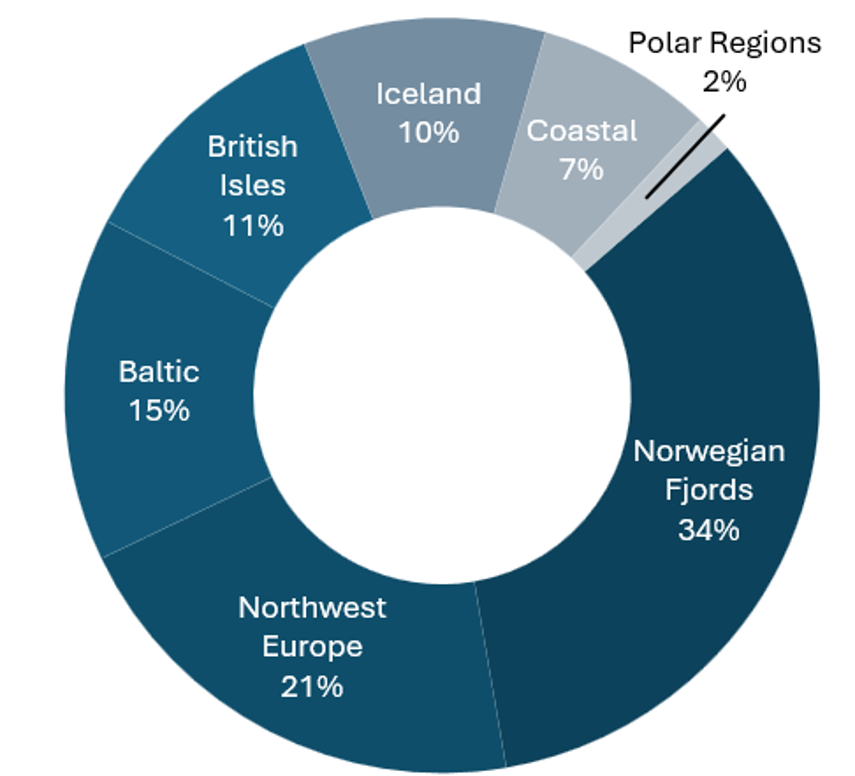
Source: BA database. Based on lower berths in 2025
It follows that the operators expanding most aggressively here, AIDA and TUI out of Germany, P&O from the UK, are precisely those whose home markets are largest and closest. AIDA's growth in particular illustrates that proximity in action: its 72% growth was fueled by launching larger vessels and expanding its year-round regional cruises. TUI's growth is due primarily to its newbuild program: their capacity grew 42% in lower berths across three ships, introducing its larger InTUIition class. Viking's growth follows a similar newbuild pattern, having added ten new ships since 2019.
These regional growth figures are actually understated for both AIDA and TUI, as they do not yet account for the unexpected winter capacity added when geopolitical disruptions in the Middle East forced them to redeploy AIDAprima and Mein Schiff Flow to winter Northern European itineraries.
American operators, by contrast, are deploying here as a premium summer placement rather than a home market strategy. The Norwegian fjords appear to be the most popular route, with ships also sailing the polar regions, Baltics, British Isles, and Iceland.
Top 10 Northern Europe Operators
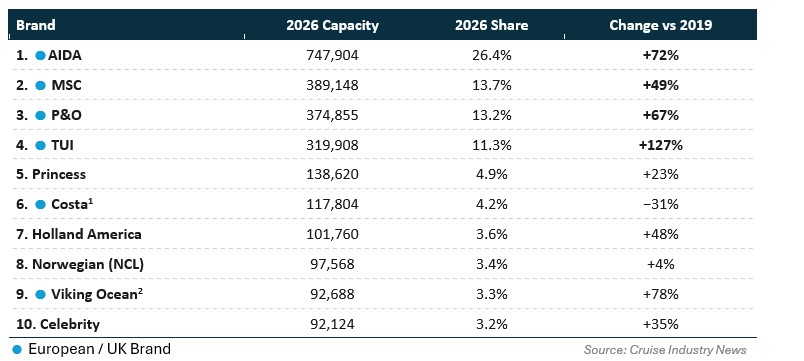
1 Costa's 31% decline reflects Carnival Corp.'s transfer of three ships to Carnival Cruise Line, leaving Costa with a smaller fleet across its European programs. 2 Viking is fundamentally a European brand by origin, identity, and corporate structure; however it heavily targets North American consumers.
Fleet growth has given operators more deployment choices than ever before, and the ships they are choosing to send to Northern Europe reflect the region's standing. Global newbuild capacity has trended larger for over a decade: since Oasis of the Seas entered service in 2009 as the first ship to exceed 5,000 lower berths, the upper boundary has continued to rise, reaching 5,668 berths with Utopia of the Seas in 2024, with Carnival's Project Ace ships, the first arriving in 2029, estimated above 6,000 berths.
Deployment decisions, made years in advance, reflect a calculated optimization of vessel size, itinerary length, source market demographics, operational cost, and revenue potential. Most of that largest-class tonnage goes to the Caribbean. But that escalation benefits Northern Europe two ways: as newer, larger ships enter the global fleet, the tonnage they displace cascades into Northern Europe's core itineraries, while the region has also secured newbuild commitments of its own.
Viking has added ten new ocean ships fleet-wide since 2019; seven of those have entered Northern Europe service, with two further newbuilds scheduled to sail the region starting in 2027 and 2028. TUI Cruises delivered Mein Schiff 7 directly to Northern Europe in 2024, with two more newbuilds on order for 2031 and 2032 citing Northern Europe expansion as part of the rationale. Explora Journeys, Cunard, and MSC have each added new tonnage as well.
The cascade effect is just as direct. When AIDAcosma entered service in December 2021, it took over AIDAnova's Mediterranean itineraries, freeing AIDAnova (5,400 lower berths, built 2018) for Northern Europe. Since 2022, AIDAnova has run full summer seasons from Hamburg and Kiel on Norwegian Fjord and Baltic routes previously served by the smaller AIDAprima and AIDAperla (3,250 lower berths each).
TUI followed the same pattern. As newer, larger InTUItion-class ships come online, they've taken over Northern Europe routes previously served by smaller vessels.
Northern Europe has traditionally been a summer market, with most operators running May through September programs before repositioning to warmer regions for winter. That pattern is changing.
Summer still anchors the season, May through August remains the busiest stretch by a large margin, but its share of total annual sailings has declined slightly, not because summer demand has softened, but because more sailings are now distributed across the rest of the calendar. Shoulder months on both sides of peak season have picked up share, spreading a growing number of total sailings more evenly across more of the year rather than concentrating them in a shorter summer window.
Winter remains the smallest piece of the calendar today, but it's where operators are testing forward-looking bets. AIDA is offering "Winter in Norway" itineraries from Kiel, complementing its year-round North Sea and Baltic sailings from Hamburg. Viking is operating "In Search of the Northern Lights" cruises in January and February. Cunard has an Arctic Circle sailing scheduled for February 2027. Christmas markets and Northern Lights itineraries are emerging as distinct product categories.
A broader season is a different kind of opportunity than summer growth. More calls in the shoulder months, and eventually deeper into winter, spread revenue across a longer calendar and reduce the concentrated infrastructure pressure of peak summer.
Share of Northern Europe Sailings by Month, 2023 vs. 2026
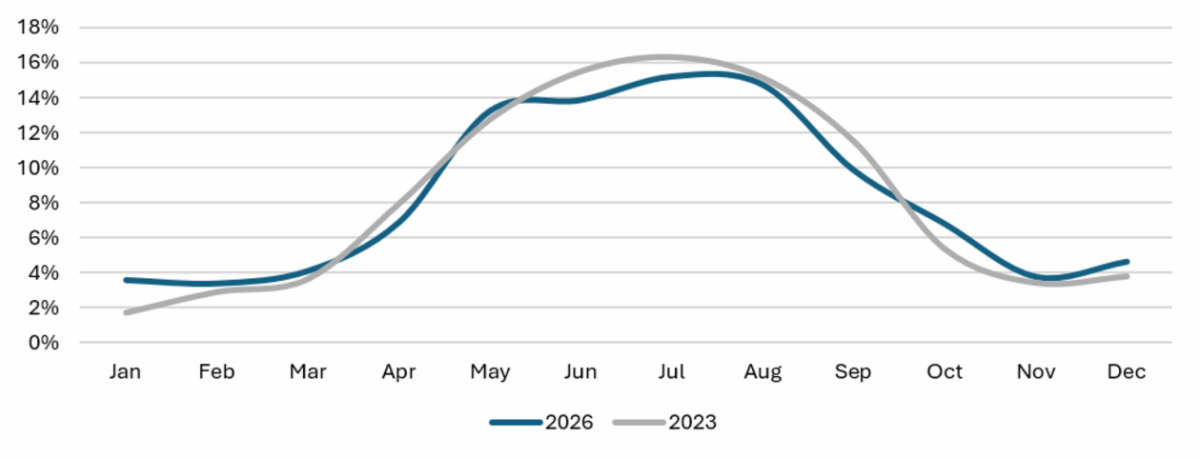
Source: BA database.
The capacity being added to Northern Europe, including more ships, larger ships, and a longer operating season, is increasingly being matched on the shore side. In recent years, ports across the region have completed a series of cruise-related infrastructure investments, with a larger pipeline committed through the end of the decade.
Across the ports highlighted here, which are not an exhaustive list of the region's total investments, an estimated $535 million has been committed to cruise infrastructure since 2020 (converted at current exchange rates; Hamburg and Greenock's costs are not publicly disclosed and are excluded from this total).
Northern Europe Port Infrastructure Investment Highlights
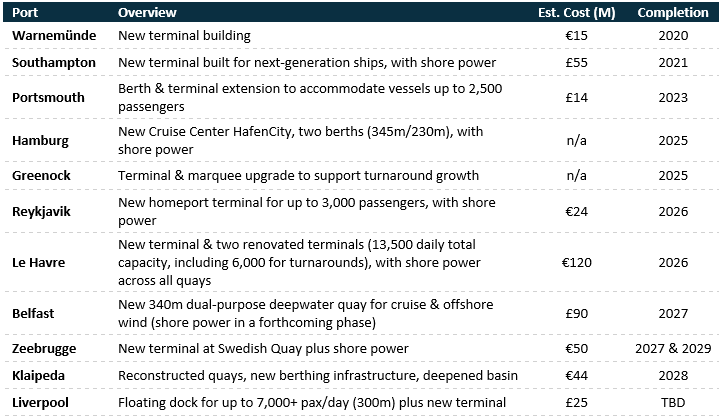
Source: BA database; online news announcements. Does not include all regional investments. Costs as reported in announced currency.
The completed projects cluster around the region's turnaround ports, as they position for homeport growth. Warnemünde, Southampton, Portsmouth, Hamburg, Greenock, and Reykjavik have each added or upgraded homeport facilities since 2020, and Le Havre's €120 million Pointe de Floride redevelopment is the largest single commitment in the region. Its new Verrazzano terminal became fully operational this spring, giving the port combined daily capacity for 13,500 passengers across all three terminals.
The vessel-size trend described earlier is also driving its own wave of investment. Belfast's deepwater quay and Liverpool's planned floating dock, designed to berth two 300-meter ships simultaneously, are direct responses to the cascade of larger ships onto the region's itineraries. Klaipėda's reconstruction of its Winter Harbour quays reflects the same pressure, roughly 40% of ships now calling there already exceed 290 meters.
The table also doesn't capture one of the region's biggest infrastructure stories: shore power. Driven largely by the EU's Fit for 55 package, which requires TEN-T core ports to provide shore power by 2030, ports across Northern Europe are moving well ahead of that deadline. Hamburg now offers shore power at all three of its cruise terminals, four years ahead of the EU mandate, and already supplied 162 cruise ships with shore power in 2025, a 71% utilization rate among shore-power-capable vessels calling there. BA's database shows 21 ports in Northern Europe with shore power already active today, and 19 more with funded or planned installations in the coming years.
Not every port is chasing this growth. Amsterdam is moving the opposite direction: cruise calls at the Passenger Terminal Amsterdam are capped at 100 per year starting in 2026, down from 190, with the terminal reduced to a single berth and shore power mandatory from 2027. The city is now debating closing the terminal outright by 2035 rather than relocating it, a reversal of the relocation plan long assumed to be the likely path. Norway faces its own deadline: ships sailing the World Heritage fjords must be zero-emission by 2032, a requirement directly impacting the roughly one-third of regional capacity that sails there.
Regulation has largely supported this growth so far, with many ports investing ahead of mandates. This outlook assumes that pattern holds, and that no further regulatory tightening reshapes where and how operators can sail in the region. Amsterdam's caps and Norway's 2032 zero-emission deadline are early examples of that risk, and more ports may follow as EU and national policy continues to evolve. BA will continue to track the region's growth as these trends unfold.

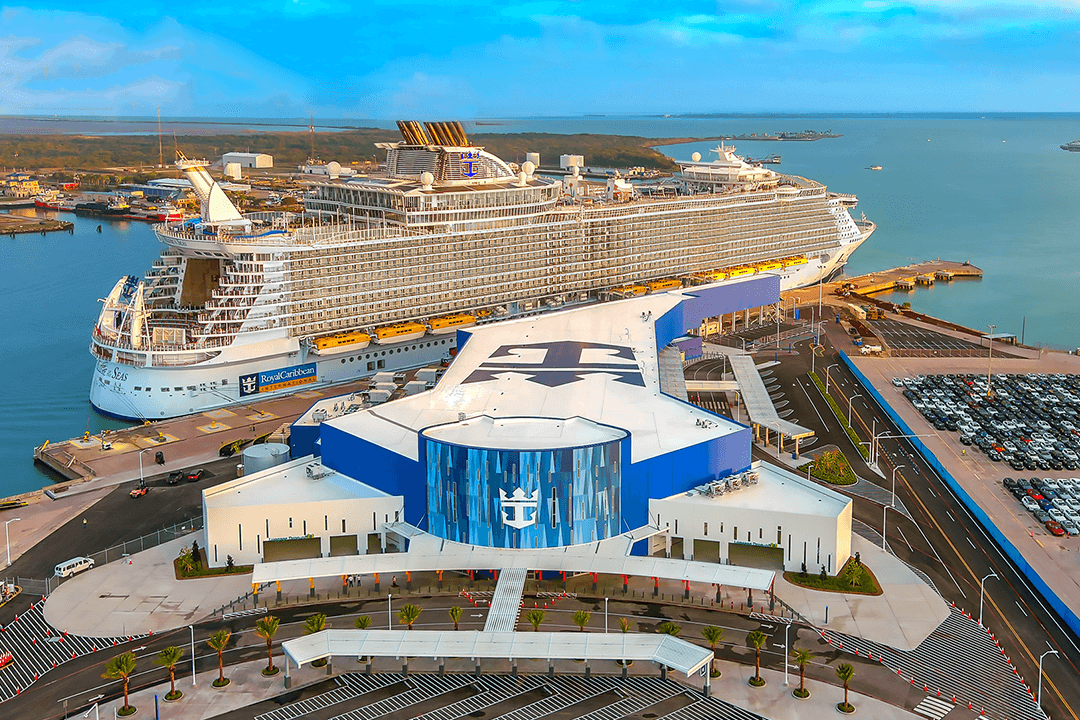
Galveston Wharves Cruise Terminal is a two story, 160,000 square-foot terminal building designed to maximize cruise terminal operations while creating a welcoming environment for passengers and crew...
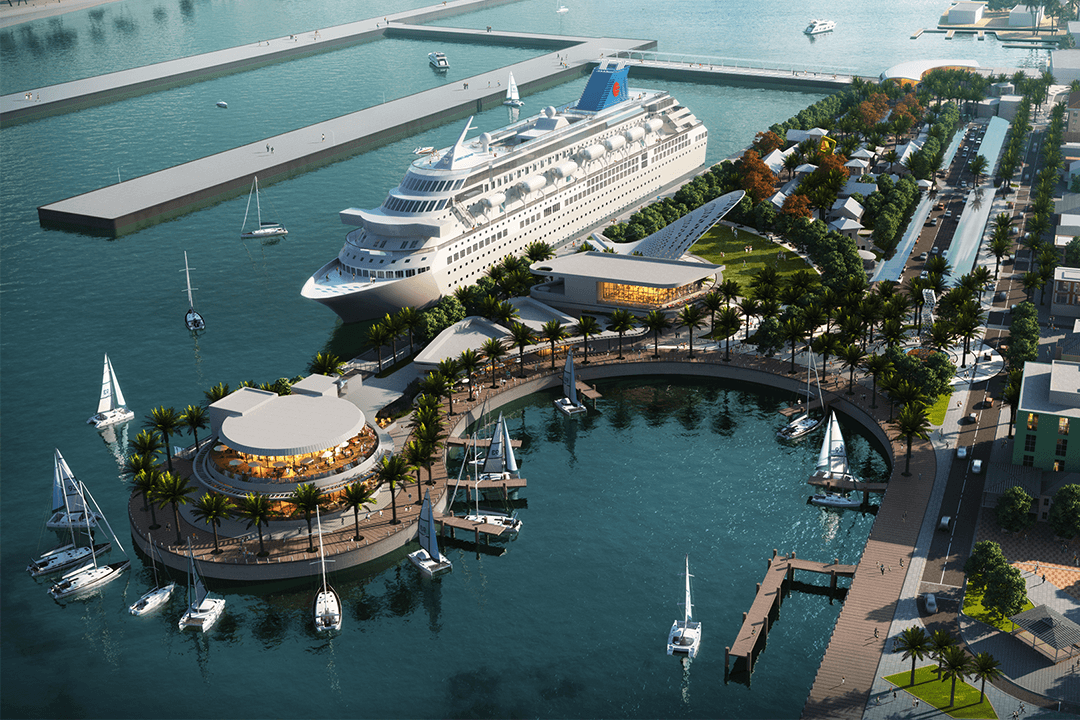
BA's design for the waterfront features a completely transformed Port and Welcome Center, additional mega berths to accommodate the largest cruise ships in the world...
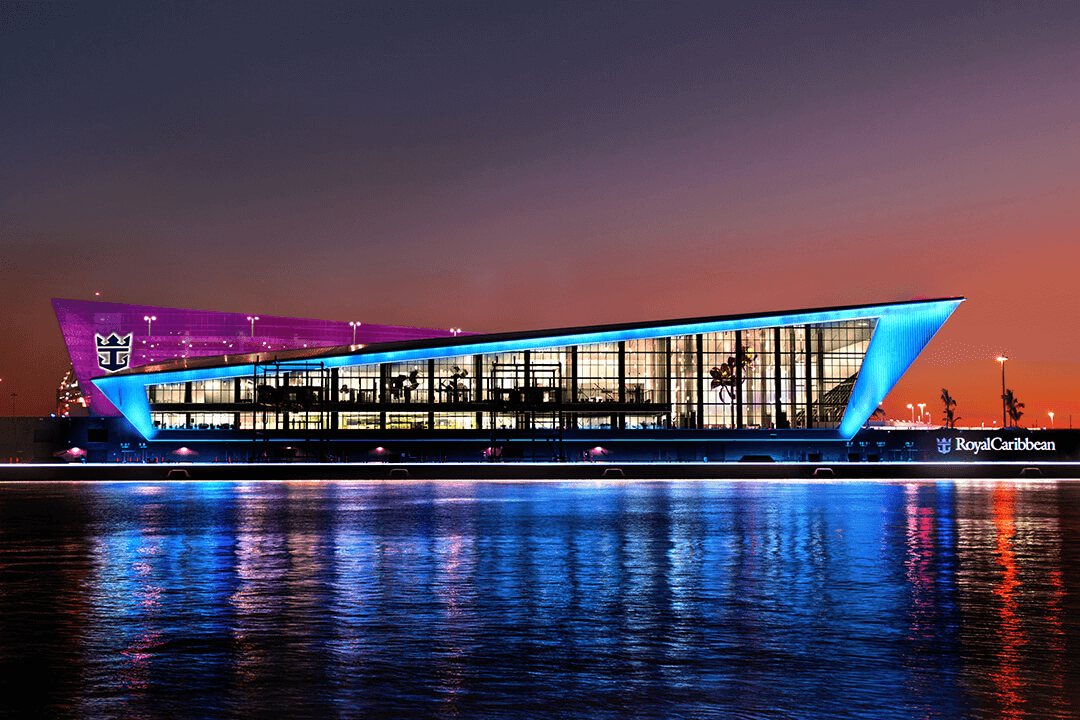
BA was commissioned by RCCL as the architect of record for the new flagship state-of-the-art high-tech Terminal A...

Bermello Ajamil & Partners, Inc. BA, in conjunction with the Renaissance Planning Group, is preparing a Master Plan of the Tampa Port Authority's Waterfront Properties...
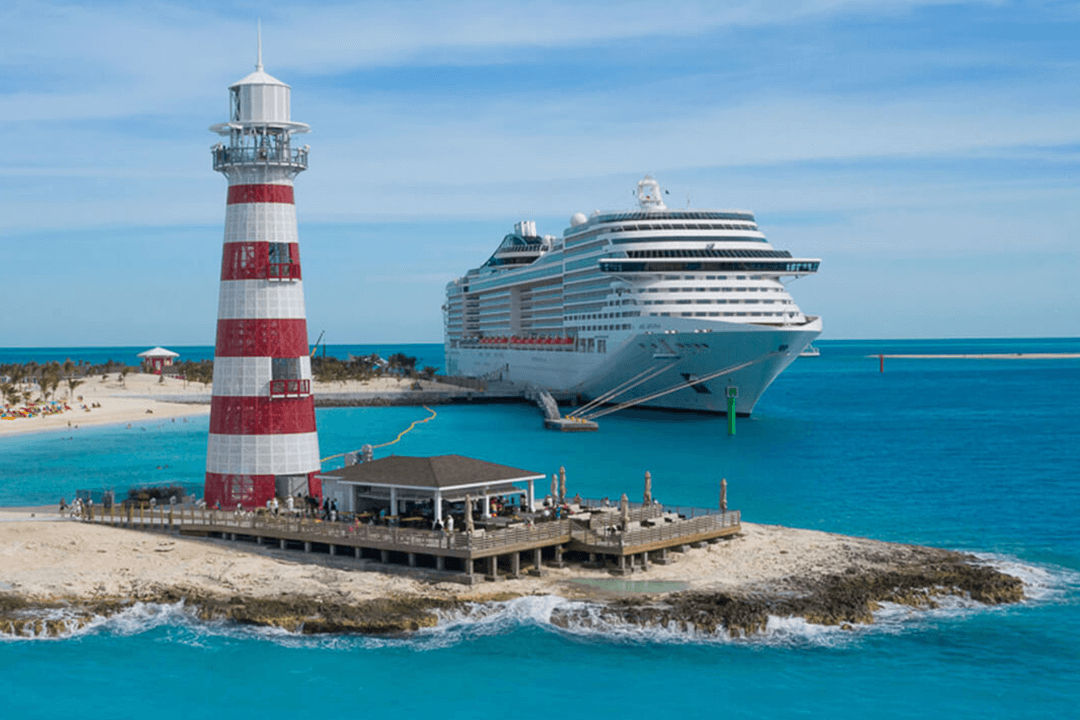
Ocean Cay was a 5-year design-build project that BA led as the prime consultant. The ultimate vision for Ocean Cay was to reinvent what a cruise destination island should be for its guests...
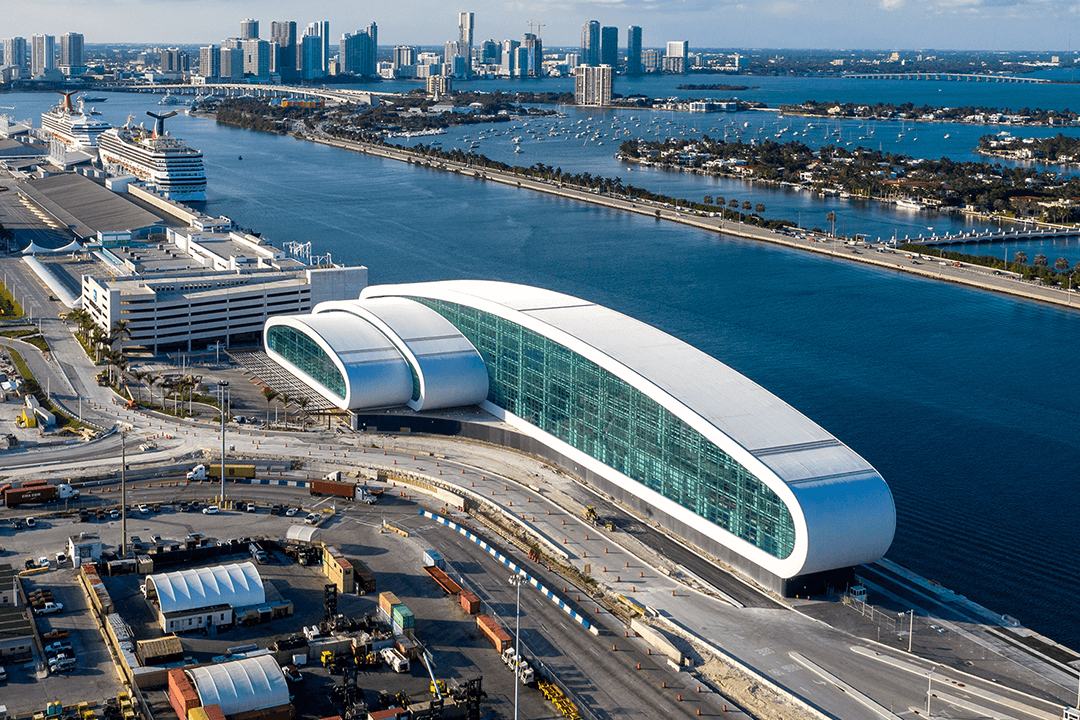
Terminal B accommodates cruise vessels of more than 5,000 passengers, and features new technology to support quicker and more efficient embarkation and disembarkation processes, as well as expedited security screening and luggage check-in...