Port Galveston Cruise Terminal 10
Galveston Wharves Cruise Terminal is a two story, 160,000 square-foot terminal building designed to maximize cruise terminal operations while creating a welcoming environment for passengers and crew...


Gain deeper insights into the maritime industry with detailed updates on key developments and trends, meticulously curated by our team of specialists.
Where capacity is shifting, how private destinations are shaping itineraries, and what the operators said about the year ahead.
Carnival Corporation (Carnival), Royal Caribbean Group (RCG), and Norwegian Cruise Line Holdings (NCLH) have now reported third-quarter results. Demand remained strong throughout the quarter, but the more interesting story for ports and destinations is what the operators said about 2027.
In this edition of BAPerspectives, we look at where capacity is shifting, how continued investment in private destinations is influencing itinerary planning, and how the operators are positioning for the year ahead.
All three operators reported stronger-than-expected close-in demand in the third quarter, although they differ on whether later booking is becoming a lasting behavior. Carnival credited "strong close-in demand and robust onboard spending," RCG pointed to close-in demand "particularly in Europe and the Caribbean," and NCLH described "extraordinary close-in demand by consumers who deferred summer vacations."
RCG sees more evidence that later booking is becoming an established behavior. Jason Liberty, RCG's chairman and CEO, said RCG has been "somewhat surprised to the upside on close-in demand" almost every quarter for three or four years, tying that to two things: more weekend getaways and shorter cruises which book closer to sailing, and a guest base that is half millennial or younger.
John Chidsey, NCLH's chairperson and CEO, was cautious about NCLH's quarter. "I don't think one quarter does a trend make," he said, and NCLH's fourth-quarter guidance assumes the close-in bookings will not continue. NCLH also wants guests to commit earlier, and Chidsey conceded that "if you wait with Norwegian, you've gotten a better deal over time."
Josh Weinstein, Carnival Corporation's President & CEO, linked part of Carnival's demand to next year. He said many guests decided this spring and early summer to put off European cruising, in effect saying "we're not going this year, but we are going next year," which he said bodes well for 2027.
The operators shared their 2027 deployment plans this quarter (summary table below). For Carnival, Europe will increase from 31% of capacity in 2026 to 34% in 2027, tying the Caribbean as the corporation's largest deployment region for the first time. With Carnival's overall capacity growing by only about 0.5% next year, the increase reflects a shift in existing deployment rather than broader fleet growth.
Weinstein tied the move to growing interest in "coolcations" in Northern Europe, where the brands can also "push into the shoulders more" and run longer seasons. BA's recent Northern Europe Spotlight tracked the region's rising share of global cruise capacity.
Carnival Corporation's European deployment is influenced by its portfolio of European-focused brands, including AIDA, Costa and P&O Cruises. Carnival Cruise Line itself remains more Caribbean-focused, with a deployment profile similar to Royal Caribbean International (RCI).
RCG's 2027 deployment stays similar to 2026. The Caribbean accounts for 56% of RCG's 2027 capacity, Europe 16%, Asia Pacific 11% and Alaska 5%, while overall capacity grows about 4.5%. NCLH raised its Caribbean deployment from 30% in 2025 to 40% in 2026 and plans to hold that share in 2027. Europe will account for 20% of 2027 capacity. Outside the three public operators, MSC Cruises moves in the opposite direction from Carnival, with its Caribbean share increasing from 34% in 2026 to 38% in 2027 and Europe declining from 48% to 44%.
Share of Deployed Capacity by Region, 2026 versus 2027
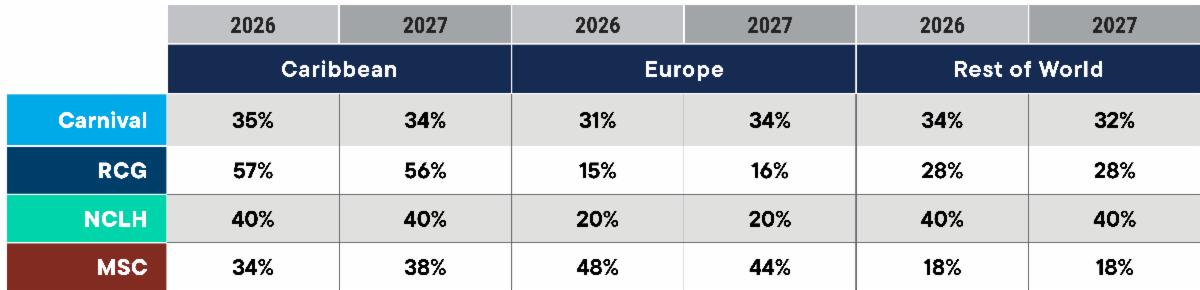
Sources: Operator earnings materials, MSC estimates from BA itinerary database.
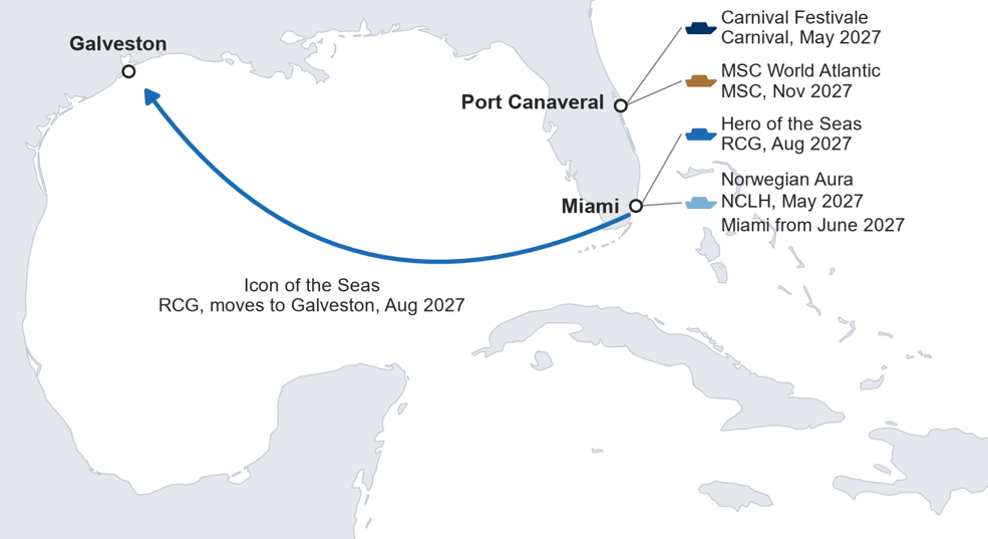
Four new ships are scheduled to join the three public operators' fleets in 2027, three of which will ultimately be based in Florida. Carnival Festivale begins sailing from Port Canaveral in May, while Norwegian Aura opens in the Mediterranean before moving to Miami in June. Hero of the Seas, RCI's next Icon-class ship, takes over the seven-night Caribbean program from Miami in August. NCLH's fourth delivery, Oceania Sonata, begins sailing in Europe before repositioning to the Caribbean later in the year. Outside the three public operators, MSC World Atlantic will also debut from Port Canaveral in November, adding another World-class ship to the Caribbean market.
As Hero arrives in Miami, Icon of the Seas will move to Galveston, becoming the first Icon-class ship based there. RCI's Michael Bayley said the Galveston move "sets the table really for the future as it relates to those itineraries, particularly when we work our way through everything with Mahahual and Cozumel." RCG gave no update on its Mahahual project.
Major new ship capacity continues to be concentrated in Florida and the Caribbean, while Icon's move to Galveston extends the largest ship classes farther into the Western Caribbean.
Key 2027 Caribbean Homeport Additions and Changes
Private destinations have long been part of Caribbean cruise deployment, but recent investments are increasing their capacity and role in itinerary planning. At NCLH, Great Stirrup Cay's new two-ship pier and waterpark have already influenced itinerary planning. In August 2025, NCLH projected 1.2 million guests for the island in 2027. NCLH now expects about 1.4 million after reworking its 2027 itineraries to "get another 200,000 people on the island." The new Great Tides waterpark, open since September, is the highest-rated experience on the island, and 90% of surveyed guests say they would recommend it. NCLH said the near-term benefit shows up mainly in onboard revenue, and it also expects the expanded island experience to eventually support higher cruise fares on itineraries that include Great Stirrup Cay.
With a second pier open at Celebration Key, Carnival expects the destination to welcome about 3.5 million guests in 2027, up from 2.7 million in 2026, as the number of ships calling increases from 26 to 31. Princess ships begin calling at Celebration Key in November, with AIDA and Costa to follow late next year.
RelaxAway at Half Moon Cay in the Bahamas and Isla Tropicale in Roatán, both recently expanded, are expected to increase from a combined 1.9 million guests in 2026 to 2.8 million in 2027 (Carnival did not report destination-specific figures).
More than one-third of Carnival Cruise Line's 2027 Caribbean capacity will call at both Celebration Key and RelaxAway on the same sailing.
At its Q2 earnings call in July, RCG projected just under four million guests at Perfect Day at CocoCay in 2026. New from this quarter's call is the company's destination push beyond the Caribbean. Asked about opportunities outside the region, Liberty said that RCG has "well over 100 different destination projects in some form or fashion going on." The company did not elaborate on what it considers a destination project or the scale and status of those projects. One concrete example is the Royal Beach Club at Lelepa in Vanuatu, where Bayley said groundbreaking was planned for November and the product is already "very attractive in the Australian market." RCG will base three ships in Australia in 2027 and four in 2028.
Unlike RCG's private destinations, RCG confirmed that its roughly $3 billion investment in Sandals and Beaches Resorts is not intended to turn the resorts into new port-of-call destinations. Instead, it expands RCG's reach into land-based vacations as the company looks to capture more of its guests' overall vacation spending. Liberty said RCG captures only 20% to 25% of what its guests spend on vacations each year, and that about 30% of them have stayed at a Caribbean all-inclusive resort in the last two years.
The deal includes a 50% stake in Sandals and Beaches Resorts, which has 18 existing resorts across the Caribbean, three resorts under development and more than 1,000 acres of undeveloped land. Naftali Holtz, RCG's CFO, said most of that land sits next to existing resorts and will go to room expansions, with "a couple of opportunities to do greenfield development." The deal is expected to close in early 2027.
Liberty said the two businesses will look for "pre, post" connections with RCG's cruise brands, creating opportunities to pair cruise and resort stays while keeping the two experiences distinct. He called resort stays additional vacations for RCG guests, and Holtz said they add to cruising rather than replace it, similar to what RCG has seen with river cruising. This is an interesting development given that cruise lines have long cited the broader vacation market, rather than simply other cruise lines, as their competition.
Carnival, when asked on its Q3 call about any similar plans for all-inclusive deals, said, "We are very proudly a cruise company."
Cruise deployment has always followed consumer demand, destination appeal, and the ability to build an attractive and profitable itinerary. As the fleet grows, operators have more capacity to place across established and developing regions. The 2027 plans show both sides of that growth: new ships entering key markets and existing ships shifting to regions where operators see stronger opportunities. The global orderbook has 87 ships on order through 2039, so that competition for future deployment will continue well beyond 2027.
The Caribbean provides the clearest example of how that competition is changing. The region continues to attract some of the industry's largest new ships, while cruise lines are also investing heavily in destinations where they have greater control over the guest experience and economics. At Great Stirrup Cay, NCLH expects the expanded destination to support onboard revenue in the near term and eventually higher cruise fares, and has already adjusted its 2027 itineraries to bring another 200,000 guests to the island.
Shorter cruises add another dynamic. On a three- or four-night itinerary, there are fewer available port-of-call slots, and cruise line-owned destinations may occupy one or more of them. Longer itineraries, however, still account for the majority of Caribbean capacity. In 2026, sailings of six nights or longer account for approximately 55% of Caribbean capacity, or 9.2 million passengers. Those sailings require a broader mix of destinations, leaving significant opportunities for traditional ports alongside the lines' own destinations.
These opportunities extend beyond the Caribbean. Carnival's 2027 shift is a strong signal for European demand, particularly in Northern Europe, where it also sees opportunities to extend the season. At the same time, continued fleet growth gives operators additional capacity to place across established and developing regions rather than relying solely on redeployment.
As the fleet continues to grow, cruise lines will have more capacity to allocate and more choices about where to place them. For ports and destinations, capturing that growth will depend on a combination of destination appeal, geographic fit, berth availability, the ability to accommodate the ships being deployed, and sufficient capacity for guest experiences ashore.
The strongest opportunities will be for ports that can deliver an experience guests value while meeting the operational and commercial needs of the cruise lines serving them.

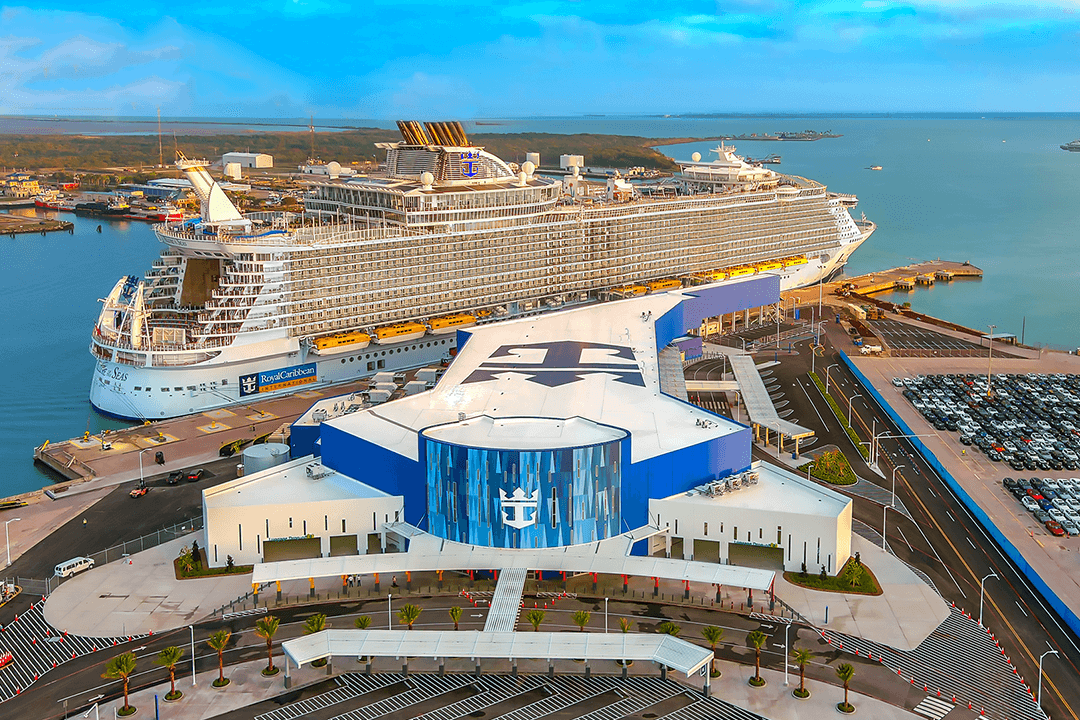
Galveston Wharves Cruise Terminal is a two story, 160,000 square-foot terminal building designed to maximize cruise terminal operations while creating a welcoming environment for passengers and crew...
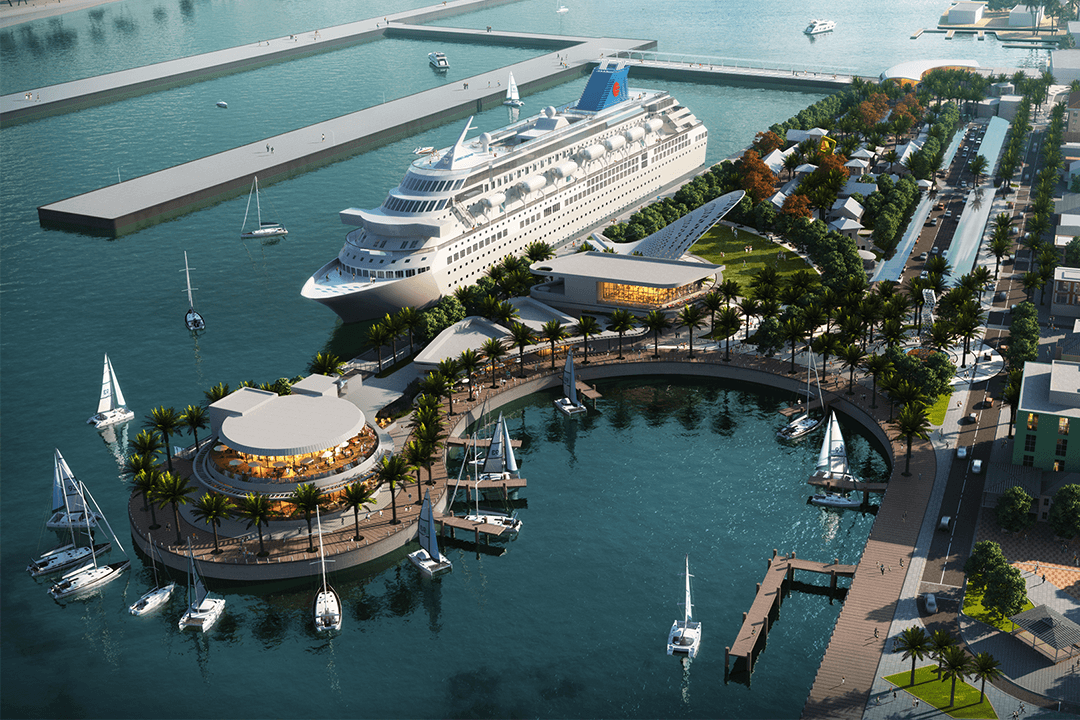
BA's design for the waterfront features a completely transformed Port and Welcome Center, additional mega berths to accommodate the largest cruise ships in the world...
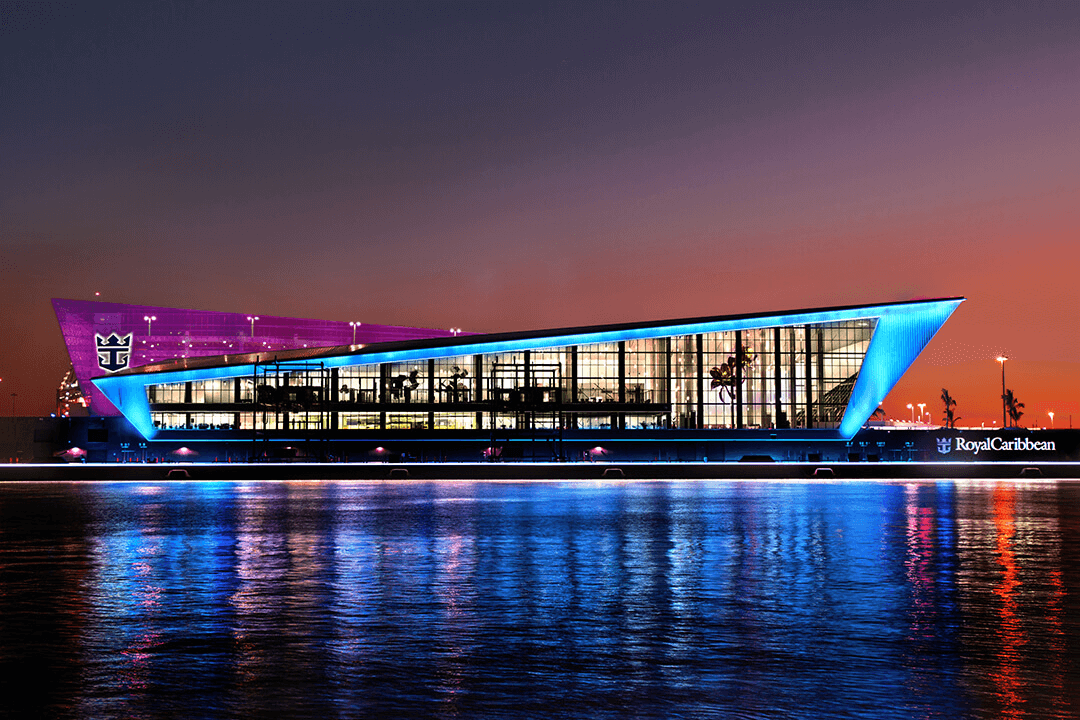
BA was commissioned by RCCL as the architect of record for the new flagship state-of-the-art high-tech Terminal A...

Bermello Ajamil & Partners, Inc. BA, in conjunction with the Renaissance Planning Group, is preparing a Master Plan of the Tampa Port Authority's Waterfront Properties...
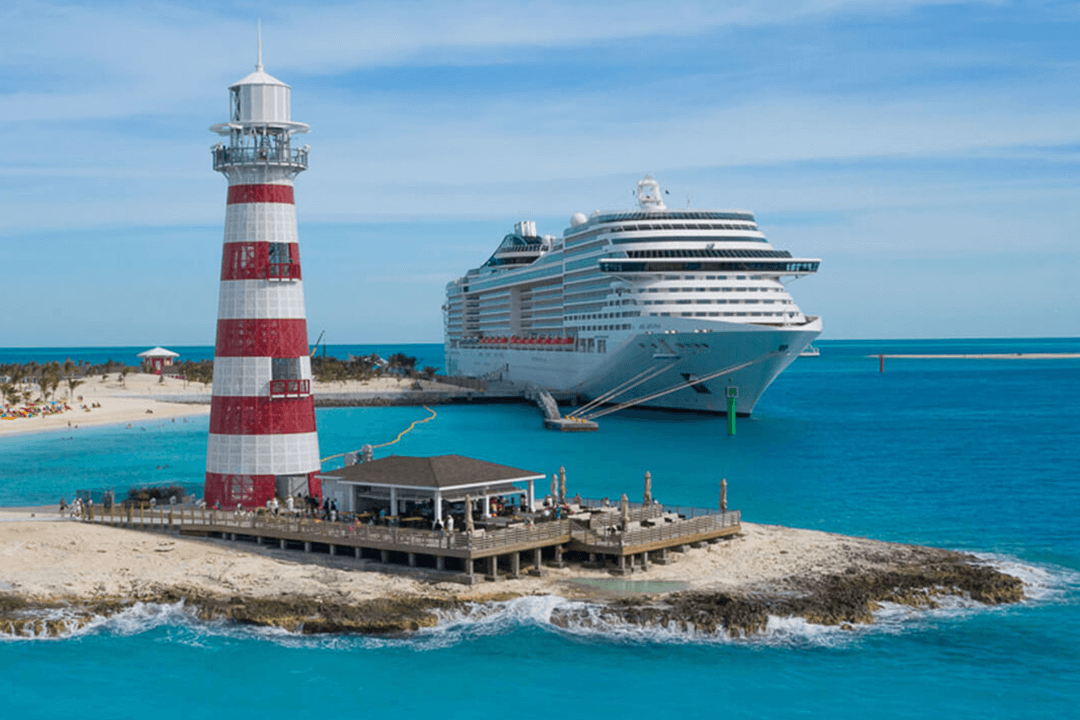
Ocean Cay was a 5-year design-build project that BA led as the prime consultant. The ultimate vision for Ocean Cay was to reinvent what a cruise destination island should be for its guests...
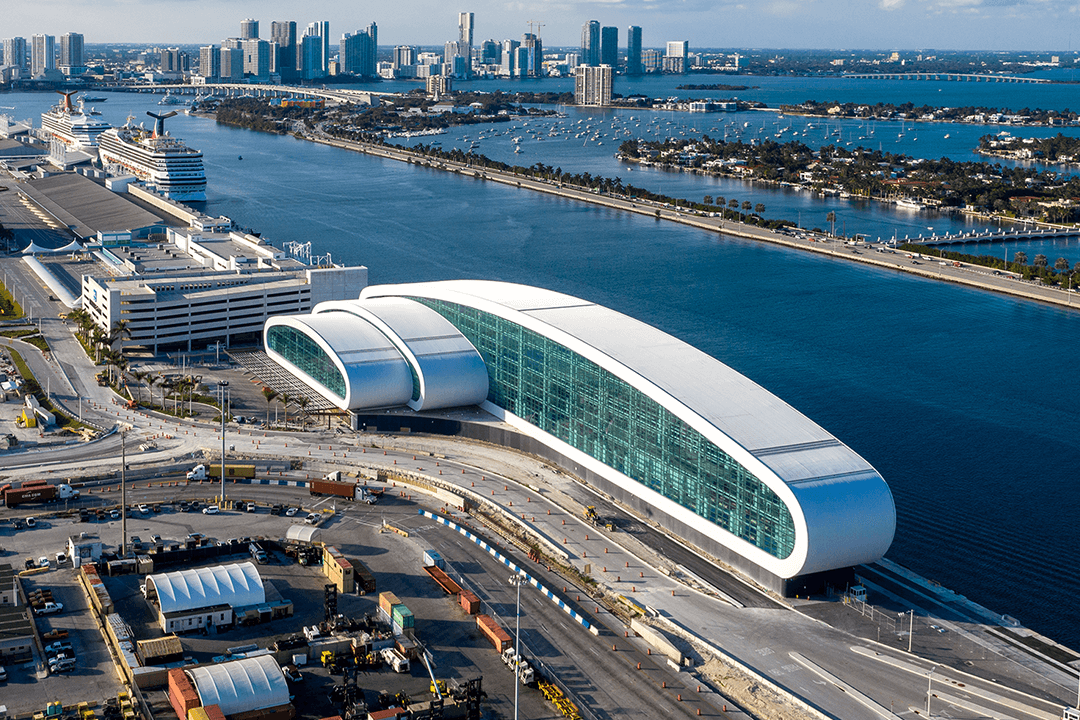
Terminal B accommodates cruise vessels of more than 5,000 passengers, and features new technology to support quicker and more efficient embarkation and disembarkation processes, as well as expedited security screening and luggage check-in...